Mantradao staking: legacy reward vesting
· updated
MANTRA DAO was the DeFi project renamed MANTRA in 2022. Its legacy incentive for eligible OM staked before MANTRA Chain’s mainnet launch specified rewards in mainnet staking coins, with a four-month cliff followed by 44 months of linear vesting. The original staked ERC-20 principal remained separate.
How staking snapshots shaped the entitlement
Snapshots tracked eligible legacy OM staking before MANTRA Chain launched on October 10, 2024. Recorded staking duration determined the entitlement, which the plan described as up to a 1.35x multiple on staked OM. Rewards did not continuously compound, and that multiple was not a recurring annual yield.
MANTRA’s legacy OM Distribution Updates reserved 17.5% of genesis supply, or 311,111,112 mainnet OM, for this incentive. The percentage described the program’s overall allocation from genesis supply. Each participant’s entitlement depended on the eligible staking recorded by the snapshots. The plan directed any undistributed incentive coins to the community pool.
What the cliff and linear vesting controlled
The plan specified distribution of reward allocations at mainnet launch, subject to vesting. An allocation established the reward entitlement; the vesting schedule governed when those coins became available.
The four-month cliff delayed unlocking. The following 44-month linear period spread the release progressively over time. These were consecutive parts of the incentive’s reward schedule, so an allocation at launch did not mean that its full amount was immediately unlocked.
The principal had a separate migration timetable
The legacy OM used to earn the incentive remained legacy tokens. Receiving a mainnet-coin reward allocation did not automatically convert that principal into native staking coins. Principal conversion belonged to a separate migration process.
The token version mattered. Facilitation of migration for the original OMv1 token stopped with MANTRA Chain’s launch in October 2024. The later migration window for Ethereum OMv2 ended on January 15, 2026. MANTRA’s August 25, 2025 deprecation announcement stated that OMv2 tokens not migrated by that deadline would be considered forfeit and their mainnet equivalents reclaimed by the MANTRA Chain Association. Those cutoffs concerned legacy-token migration and were separate from the incentive reward’s vesting timetable. The longer reward schedule did not extend either migration window.
Reading later balances in MANTRA units
Historical incentive amounts were expressed in mainnet OM. MANTRA’s native coin redenomination on March 2, 2026 changed one native OM into four MANTRA. Allocations scaled proportionally under the split. A larger unit count resulting from that conversion alone did not establish that more of a reward had vested.
New native staking rewards belong to a different mechanism. Native MANTRA staking secures MANTRA Chain through delegated proof-of-stake, with staking rewards funded through chain inflation. The historical snapshot entitlement and its cliff-plus-vesting schedule apply to the legacy incentive allocation, rather than every reward earned through native staking.
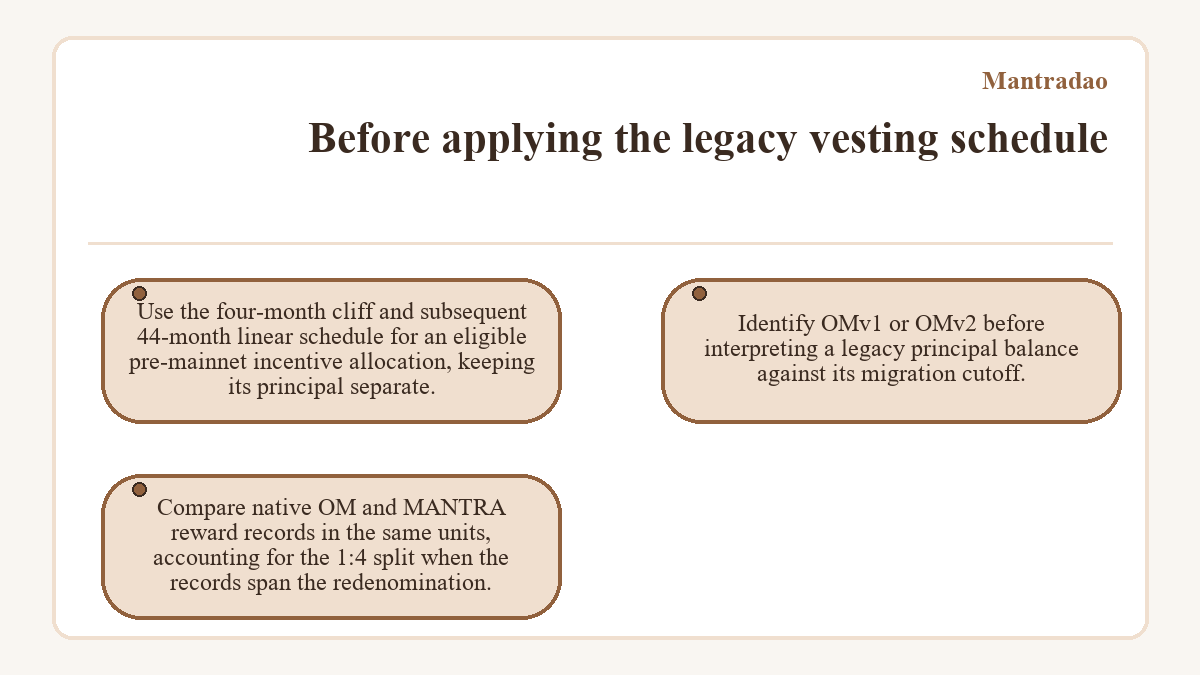
Before applying the legacy vesting schedule
- Use the four-month cliff and subsequent 44-month linear schedule for an eligible pre-mainnet incentive allocation, keeping its principal separate.
- Identify OMv1 or OMv2 before interpreting a legacy principal balance against its migration cutoff.
- Compare native OM and MANTRA reward records in the same units, accounting for the 1:4 split when the records span the redenomination.